
AI is repricing IT Services. Here’s where the value is moving
The market is already pricing a shift in how IT services companies make money. What it means if a sale is on your horizon.
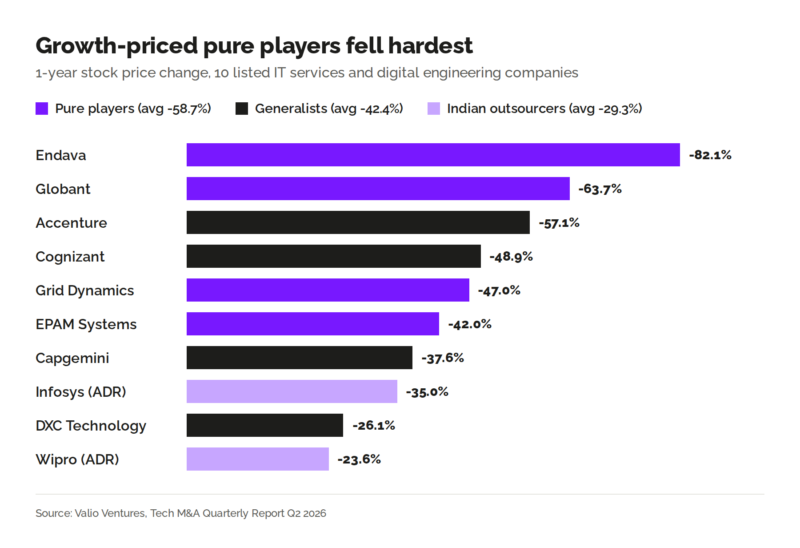
For two decades, IT services grew on a simple model: more people, more billable hours. AI is challenging that model, and the market is already pricing it in. According to our Q2 2026 LatAm Tech M&A Report, all 10 listed IT services and digital engineering companies we track lost value over the past 12 months, and the growth-priced pure players fell hardest, 58.7% on average.
But the story isn’t only a decline. The same market that is discounting the traditional model is starting to reward a different one: AI delivered as a product, sold on consumption or output rather than on hours.
That contrast is the clearest signal of what is happening across the sector. The market isn’t writing off IT services. It is repricing the old model and starting to reward the new one. If you run an IT services company, or are thinking about selling one, it’s worth understanding that shift before a buyer explains it to you.
Why the old model is being repriced
CRISIL Ratings expects IT services growth of just 1–3% this year and next, the slowest pace in four years. The reason goes beyond cautious spending. As CRISIL’s Anuj Sethi put it, “AI is no longer just a productivity lever; it is beginning to challenge their traditional revenue model.” Clients are using AI to renegotiate contracts, and pricing pressure is becoming structural rather than cyclical.
Jefferies has made the mechanism explicit. Generative AI is automating the work that used to require large, stable teams: code updates, infrastructure troubleshooting, documentation. That work was the backbone of recurring managed-services revenue. What remains shifts toward advisory, implementation and AI integration, work that is more valuable per engagement but more dependent on clients’ appetite to invest. A business built on predictable, contract-backed revenue starts to look more like a project business, and project businesses are priced differently.
Scale doesn’t make a company immune. In our public panel, the largest diversified firms fell 42.4% on average over 12 months, and even the most resilient group, the Indian outsourcers, fell 29.3%. Size and diversification cushioned the correction, but didn’t prevent it. The market’s message is that announcing AI work is not yet proof that the model has adapted. Part of the correction may also reflect growth valuations coming back to earth, while AI’s pressure on the billable-hours model could be driving a more lasting change.
What it looks like in practice
Three recent cases show the shift from different angles.
- Accenture: bookings aren’t proof yet. Ahead of its June results, Accenture was reporting record bookings of $22.1 billion for its fiscal second quarter, and its advanced AI bookings had nearly doubled year over year. Yet its stock sat about 46% below its 52-week high. Signing AI work was not enough to convince the market that the model had adapted.
- Cognizant: the index re-weights. That same month, Nasdaq announced Cognizant would be removed from the Nasdaq-100. Analysts read it as capital moving away from firms that deploy AI for clients and toward those that build and power it.
- Globant: both sides of the shift. Argentine-founded Globant saw its market value fall from about $13 billion in late 2021 to under $2 billion this year. At the same time, it is rebuilding its offer around AI Pods, sold on consumption or output rather than hours, and annual recurring revenue from its AI offering grew 60% quarter over quarter in Q2 2026. When the stock jumped on October 1, investors were reacting to that pivot, not to a recovery of the traditional business.
What the multiples already show
The repricing is visible in deal data. In the same Q2 2026 LatAm Tech M&A Report, the median EV/EBITDA multiple for IT services M&A stood at 8.8x, down from a 13.6x peak in 2023. Private deals tell a similar story to the public markets.
But the headline multiple hides the most useful part of the story. What sets the price is no longer just being “IT services”; it’s which kind:
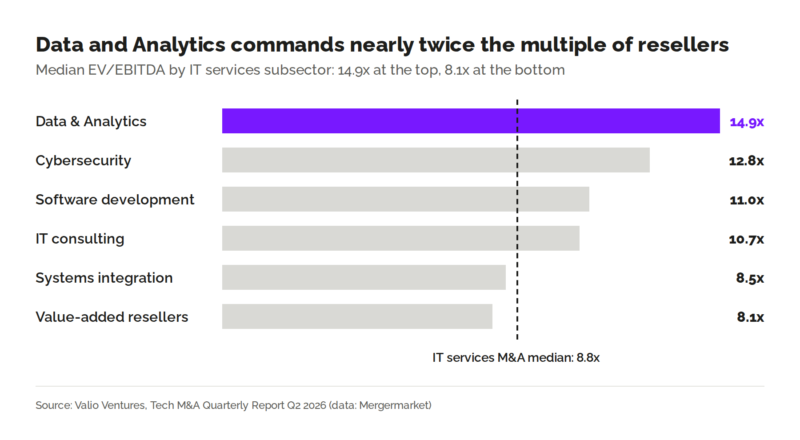
The pattern is consistent: the closer revenue sits to proprietary data, scarce skills and recurring value, the higher the multiple. The closer it sits to pass-through or labor-based models, the lower. That’s also why recurring revenue, on its own, no longer guarantees a premium. A contract that renews every year but still depends on billable hours is exposed to the same automation reshaping the sector. What buyers want to see is revenue that is durable, transferable and hard to automate away.
Where value is moving, and who is buying it
None of this means the IT services model is dying. It means value is migrating. Demand is growing for data, cloud infrastructure, cybersecurity and AI implementation. Gartner expects 40% of enterprise applications to feature task-specific AI agents by the end of 2026, up from less than 5% in 2025, and someone has to build, integrate and run them.
AI is also pushing IT services firms to rethink what they offer, how they sell, how they deliver and how they compete. Part of that change is built internally, and a growing part is acquired, because acquisitions add capabilities in months rather than years. Buyers are already acting on it, including in Latin America:
- Grid Dynamics acquired Ekumen, an Argentine robotics and physical AI engineering company, to expand its physical AI capabilities.
- Jobsity acquired Eureka Labs, an Argentine AI-driven staff augmentation firm.
- Nava took a majority stake in CS Global IT, adding multicloud consulting and governance, its third acquisition in under a year.
What we’re seeing: Strategic buyers accounted for 71% of IT services deals over the past 30 months. They aren’t buying headcount; they’re buying specialized capabilities they would take years to build.
That opens opportunities for companies that bring something complementary to the table:
- Specialized capabilities in data, cloud, cybersecurity or AI implementation that a larger player needs to deliver on its AI strategy.
- Industry specialization in sectors such as financial services, healthcare or retail.
- Client relationships that give a buyer access to accounts it doesn’t reach today.
- Access to new markets, including nearshore delivery and a presence in Latin America.
For these companies, the question isn’t only how AI affects their own model, but who would gain the most from what they’ve built, and how to position for that conversation.
FAQs:
- What is the average EV/EBITDA multiple for IT services companies in 2026? The median for IT services M&A stood at 8.8x, down from a 13.6x peak in 2023. The range is wide by subsector, from 14.9x in Data & Analytics to 8.1x for value-added resellers.
- How is AI affecting IT services valuations? AI is automating work that used to support recurring, hours-based revenue, so buyers are discounting businesses that depend on it. Services tied to data, cloud, cybersecurity and AI implementation are holding up better.
- Does recurring revenue still earn a premium in IT services? Only if it is durable. Buyers look at whether recurring revenue is transferable and resistant to automation, not just whether a contract renews.
- Who is buying IT services companies? Mostly strategic buyers, which accounted for 71% of IT services deals over the past 30 months, often to add specialized capabilities.
Sources:
- LatAm Tech M&A Report – Q2 2026. Valio Ventures, August 2026. M&A multiples (Mergermarket data), subsector spread, public panel (as of July 2026), buyer mix, LatAm deals.
- IT services growth seen muted at 1–3% on AI disruptions, weak spends. CRISIL Ratings, July 16, 2026.
- Is IT Services the First Real Example of AI Disruption?. Jefferies, March 12, 2026.
- Accenture earnings: three metrics now determine if AI consulting is real. Tech Times, June 15, 2026.
- Globant Q2 2026 earnings call highlights. Yahoo Finance, August 2026.
- Globant bets on AI Pods after shares collapse 80%. Briefs, October 1, 2026.
Thinking about selling your tech company?
If you’re exploring a sale, or just starting to think about it, we’re happy to have a first conversation. No commitment, no pressure. Just a direct talk about what your options look like today.
Discover more insights in our latest M&A reports
Subscribe to our Newsletter
Subscribe to receive the most important M&A updates for the tech sector in LatAm every month.
