
The end of the SaaS premium, and what buyers are paying for now
What H1 2026 tells SaaS founders about who is buying, what they are paying for, and why profitable companies are well placed.
On paper, 2026 looks contradictory for SaaS so far. Global SaaS M&A reached a record $439.7 billion in the first half alone, yet the multiples buyers pay kept coming down. Both things are true, and together they tell a clearer story than either number alone.
The market isn’t closing. It’s repricing. It is paying less for growth promises and more for businesses that generate cash and hold a defensible position. For founders who built profitable companies without venture capital, that shift works in their favor.
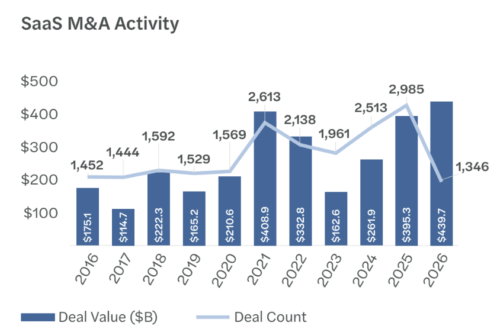
Headline value is concentrated in a handful of outlier deals, such as xAI, Cursor and Wiz. Deal count was actually lower: 1,346 transactions in H1 2026, against 1,521 in H2 2025. To understand what is happening in the mid-market, we have to look past the megadeals.
The multiple reset: what is actually being repriced
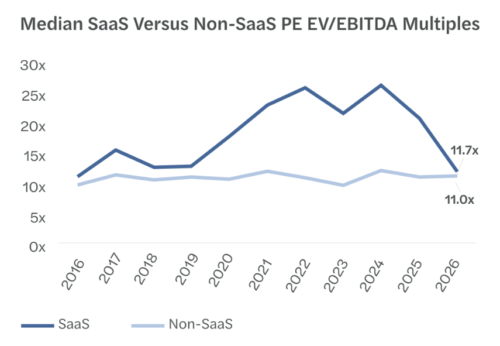
The median EV/EBITDA multiple in SaaS private equity deals fell to 11.7x in H1 2026, down from 20.4x. That puts SaaS almost level with non-SaaS companies, which sit at 11.0x. The “SaaS premium” that defined the last decade is narrowing fast.
Three forces are driving the reset:
- AI disruption risk. Buyers are pricing in the chance that AI displaces some subscription workflows.
- A focus on cash generation. Buyers want to see cash today, not only growth projections.
- A higher cost of capital. Financing stays more expensive than before the pandemic.
The reset is not limited to PE. Strategic acquisitions also dipped, to a median of 11.4x EBITDA, close to buyouts at 11.7x.
A lot of what is being repriced is growth that was never backed by earnings. A business whose value rests on EBITDA, recurring revenue and customer retention has less of that premium to lose.
The profile buyers want now
What makes a SaaS company attractive in 2026 comes down to two things: it generates real cash, and it holds a defensible market position in the age of AI. Companies without that profile face lower multiples and less available financing.
Many bootstrapped founders already fit that profile. Growing without VC money means running for profitability from day one: disciplined spending, real customers paying real contracts, and no need to show growth at any cost. For years that made them look slow next to venture-backed peers. Today it makes them look solid.
Profitability alone isn’t the full picture, though. The second half of the profile, a defensible position, is where preparation matters. That usually means specialization, low customer concentration and a product embedded in customers’ critical workflows.
What we’re seeing: Our Q2 2026 Tech M&A Report shows the same pattern from another angle. Vertical SaaS rose to 54% of SaaS deals, up from 46% a year earlier. And while median revenue multiples compressed, specialized assets with proprietary data or mission-critical workflows kept commanding premiums. Buyers aren’t discounting everything. They are separating.
Who’s buying: strategics set the pace
Strategic acquirers accounted for 88.7% of SaaS M&A value in H1 2026, or $390.1 billion of $439.7 billion. Corporates aren’t tied to a fundraising cycle, so they can fund acquisitions from their own cash flow when an asset strengthens their position.
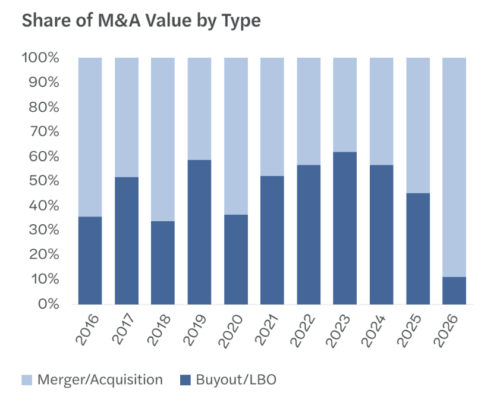
Private equity, meanwhile, has become more selective:
- Deal size. The average PE deal in SaaS fell to $256.2 million, from $448.9 million in 2025.
- Large deals. Only five PE deals topped $1 billion in H1 2026, against 29 in all of 2025.
- Financing. Software’s share of US syndicated loans for buyouts dropped below 15%, from nearly 35% in 2024.
Selective doesn’t mean absent. Exits have slowed, with SaaS PE and VC exits running at roughly 1,458 a year against 1,652 in 2025, so funds are holding assets longer. Those portfolios will eventually need to rotate, and private capital still holds trillions in dry powder. When PE does commit, it looks for defensible EBITDA and durable cash flow.
What we’re seeing: Our Q2 data shows the same shift. PE direct platform investments fell to 6.3% of SaaS deals, down from roughly 10% historically. Strategic buyers kept filling that space, including in Latin America: Norway’s Visma acquired two Brazilian SaaS companies, Dootax and Pag Útil, in the same quarter.
What strategic buyers are asking now
Strategic buyers used to pay a synergy premium almost by default. Today they are less confident those synergies will materialize. AI also lets buyers build in-house what they once would have acquired. The result is that sellers need a clear rationale, backed by numbers, for the multiple they expect.
In practice, that means being ready for three questions before the first meeting:
- Why buy you instead of building it? Proprietary data, customer relationships, regulatory know-how and embedded workflows are hard to replicate. A feature set is not.
- How durable is your cash flow? Buyers look at retention, contract length, customer concentration and how much of the business depends on the founder.
- Where does AI show up in your results? Mentioning AI is table stakes. Showing its impact on efficiency, growth or customer value, with measurable ROI, is a differentiator.
There is also a process lesson. When buyers are more demanding and fewer assumptions are priced in, talking to a single buyer leaves the seller with little leverage. A structured process with several qualified buyers is what turns a solid profile into a competitive price.
What this means for founders
The first half of 2026 didn’t close the SaaS exit market. It changed the criteria. Growth is still rewarded, but the premium now goes to growth that comes with cash, focus and a clear reason to buy.
- If you’re evaluating an exit in the next 12 months: your EBITDA and your retention are your strongest arguments. Prepare the narrative that explains why a strategic buyer should acquire you rather than build, and run a process that brings several of them to the table.
- If you’re 18–24 months away: use that time on what moves valuation, such as specialization, lower customer concentration, less dependence on the founder, and AI with measurable results.
What we’re seeing: In Latin America, Q2 2026 closed with 43 tech deals, in line with the range the region has held since mid-2024. The market for well-positioned assets remains active. Buyers are simply choosing more carefully.
Sources: Pitchbook, H1 2026 State of SaaS: Compressed Multiples, Renewed Fundamentals, & the New Exit Playbook (data: PitchBook, as of June 30, 2026) · Valio Ventures, Tech M&A Quarterly Report Q2 2026.
Thinking about selling your tech company?
If you’re exploring a sale, or just starting to think about it, we’re happy to have a first conversation. No commitment, no pressure. Just a direct talk about what your options look like today.
Discover more insights in our latest M&A reports
Subscribe to our Newsletter
Subscribe to receive the most important M&A updates for the tech sector in LatAm every month.
