
Latin America Tech M&A in H1 2026: Fewer deals, higher value
The first half of 2026 sent a clear signal to tech founders in Latin America: buyers remain active, but they have become more selective.
Fewer companies changed hands than in any first half since 2021, but total deal value increased. Capital concentrated in the assets buyers wanted most, and technology was the busiest sector in the region. For a founder thinking about a sale in the next few years, the question has shifted from “is the market open?” to “is my company the kind of asset buyers are competing for?”
Here is what we are seeing behind the H1 2026 numbers, and what it means for tech companies on the road to an exit.
Lower volume, higher value
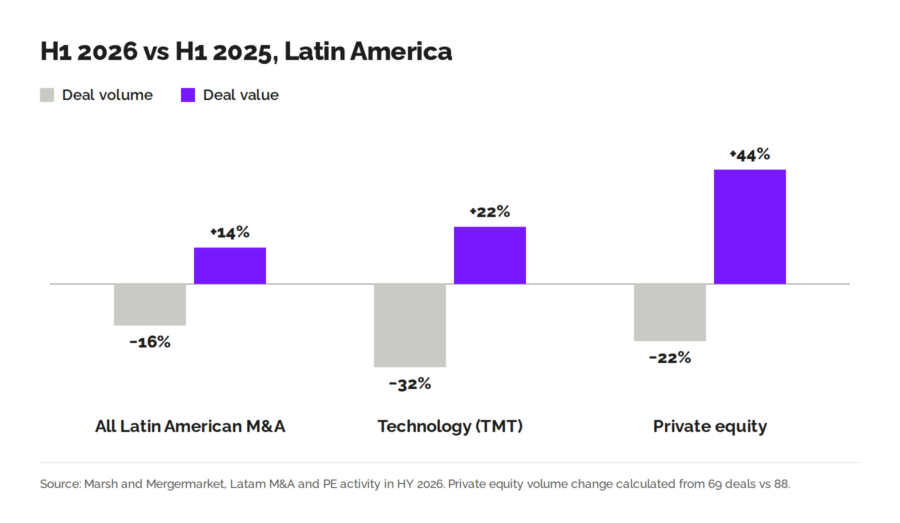
Deal count and deal value moved in opposite directions. Across Latin America, 581 transactions were announced in H1 2026, 16% fewer than a year earlier. Their combined value, however, rose 14% to US$60.4bn. Technology and private equity followed the same pattern, and in both the gap was even wider.
Several factors explain this caution. US tariffs, energy-price volatility tied to the Middle East and high interest rates (Brazil’s benchmark rate is still at 14.25%) led buyers to be more careful before committing capital.
Lower activity did not mean buyers left the market. They closed fewer deals and committed more capital to each one. This is often described as a flight to quality: buyers concentrate on the assets they consider strongest and are willing to pay more for them.
Technology remains the most active sector, with a wide range of deal sizes
Technology, media and telecoms closed 111 deals in H1 2026, more than any other sector. Volume fell 32%, but value rose 22% to US$9.1bn.
The largest transactions were in payments and telecom infrastructure, segments where scale is a key driver of value: Visa’s US$1.5bn acquisition of Prisma Medios de Pago and Newpay in Argentina, the US$1.4bn purchase of Telefónica’s Chilean business, and Macquarie’s US$952m deal for IHS’s tower operations in Brazil.
Software deals were typically smaller, but buyer interest remained steady. Strategic acquirers, local and international, continued to add software capabilities, and AI and data centers drew growing interest.
AI is a big part of what drives that interest. Across tech, companies are rethinking what they offer, how they sell and how they deliver, and M&A has become a faster way to add the capabilities that change requires. The targets are not only AI companies, but also businesses whose capabilities help a buyer get more out of AI, from data and cloud to digital engineering and cybersecurity. We look at how this is playing out in IT services in AI Is Repricing IT Services. Here’s Where the Value Is Moving
More capital is available for quality assets
Private equity mirrored the wider market: 69 deals, down from 88, but US$14.2bn in value, up 44%. Tech was where sponsors were most active, with 27 deals.
The capital available to these investors is also growing. According to Mergermarket’s latest Latin America M&A report, Mexico’s pension funds are expected to approach US$600bn in assets by 2030, and have already put around US$22bn into private equity since 2020. Brazilian family offices are increasingly investing directly. Global fund managers are raising more money aimed specifically at the region.
For sellers, this has a direct implication. More capital looking for a limited number of quality assets means more competition at the top of the market, and better terms for the companies that are ready.
What makes a tech company a quality asset right now
In a selective market, quality has two layers. The first sets the price: how much strategic value a company brings to a specific buyer. The second protects it: how easy the company is to buy.
Strategic fit: what sets the price
Buyers pay the most for companies that make their own business stronger. That usually comes down to:
- Differentiated capabilities: skills, technology or data the buyer would take years to build on its own.
- Industry positioning: deep expertise in specific verticals, where knowledge and client references are hard to replicate.
- Access to clients: relationships and accounts the buyer doesn’t reach today.
- Cross-selling potential: products or services the buyer can offer to its own clients, and the other way around.
- Synergies: cost or revenue gains that only exist when the two businesses come together.
This is what explains the wide gaps in valuation. In our Q2 2026 LatAm Tech M&A Report, IT services companies focused on data and analytics changed hands at a median 14.9x EBITDA, almost double the 8.1x paid for value-added resellers. Buyers aren’t paying for size alone; they are paying for capabilities that are hard to replace and that fit what they need.
Software shows the same pattern: vertical SaaS reached 54% of software deals in Q2 2026, overtaking horizontal software, as buyers pay for industry expertise and proprietary data that AI makes harder, not easier, to replicate.
Transaction readiness: what protects the price
Strategic fit gets a buyer to the table. Readiness keeps that value intact through the process. Four questions tend to come up:
- Who is the natural buyer? With few large IPOs outside Brazil, most investors exit by selling to a strategic buyer or to another fund. A company with an obvious strategic fit is easier to buy, and easier to sell again in the future.
- How exposed is the business to currency? Funds measure returns in dollars, while many companies earn in pesos or reais. Revenue billed in dollars, or a clear view of performance in dollar terms, reduces that risk.
- Can the numbers be trusted? Buyers increasingly rely on insurance and contract protections to cover what they can’t verify. Clean financials and well-organized information make those protections cheaper and the process faster.
- Is the timeline realistic? Elections and regulatory reviews across the region are stretching deal timelines. Starting preparation early leaves room for delays without disrupting the process.
What to expect in the second half
The number of potential transactions is growing. Around 266 Latin American companies were reported as potentially coming to market in the first half, 43 of them in tech. That means more choice for buyers, and more competition among sellers for their attention.
Several risks remain: Brazil’s presidential election, the review of the USMCA trade agreement, high interest rates in Brazil and Colombia, and energy prices. At the same time, gradual rate cuts in several markets could ease financing and unlock deals that were put on hold earlier in the year.
Why now is the time to prepare
H1 2026 did not close the market for tech M&A in Latin America, but it made it more selective. Buyers are focusing on the companies they see as quality assets, and many strategic buyers are actively looking for capabilities to add.
That makes this a good moment to start preparing. Not necessarily to sell today, but to be ready when the right opportunity appears, or to go out and look for it.
Preparation goes beyond organizing the financials for an eventual process. It means understanding which strategic buyers would gain the most from the company, what exactly they would be buying, and how to position the business in front of them. Companies that do this work early get to choose their moment, instead of reacting to it.
FAQ
- How did Latin American M&A perform in H1 2026? Deal volume fell 16% to 581 transactions, the lowest first half since 2021, while deal value rose 14% to US$60.4bn.
- Which sector had the most M&A deals in Latin America in H1 2026? Technology, media and telecoms (TMT), with 111 deals worth US$9.1bn. Volume was down 32% year on year, but value was up 22%.
- Is private equity still investing in Latin American tech companies? Yes. PE firms announced 69 deals worth US$14.2bn in H1 2026, up 44% in value, and TMT was their most active sector with 27 deals.
- What does “flight to quality” mean in M&A? It means buyers do fewer deals and concentrate their capital on the assets they see as most attractive, often paying a premium for them.
Sources:
- Valio Ventures, LatAm Tech M&A Report – Q2 2026, August 2026.
- Marsh and Mergermarket, Weathering the storm: Latam M&A and PE activity in HY 2026, September 2026.
Thinking about selling your tech company?
If you’re exploring a sale, or just starting to think about it, we’re happy to have a first conversation. No commitment, no pressure. Just a direct talk about what your options look like today.
Discover more insights in our latest M&A reports
Subscribe to our Newsletter
Subscribe to receive the most important M&A updates for the tech sector in LatAm every month.
